
Every wiring closet starts out looking fine. Then a few years, a few "quick fixes," and a few technicians in a hurry go by, and you end up with the tangle in that first photo — a multi-colored knot that looks less like a network and more like something a cat got into. It doesn't send you a memo before it costs you something, either: an afternoon of downtime nobody can quite explain, a technician playing tug-of-war with cables trying to find the right one, and in the worst cases, an honest-to-goodness fire hazard sitting behind a door nobody ever opens. Here's the process we run every time we walk into a closet like that and walk out with the rack in the second photo instead.
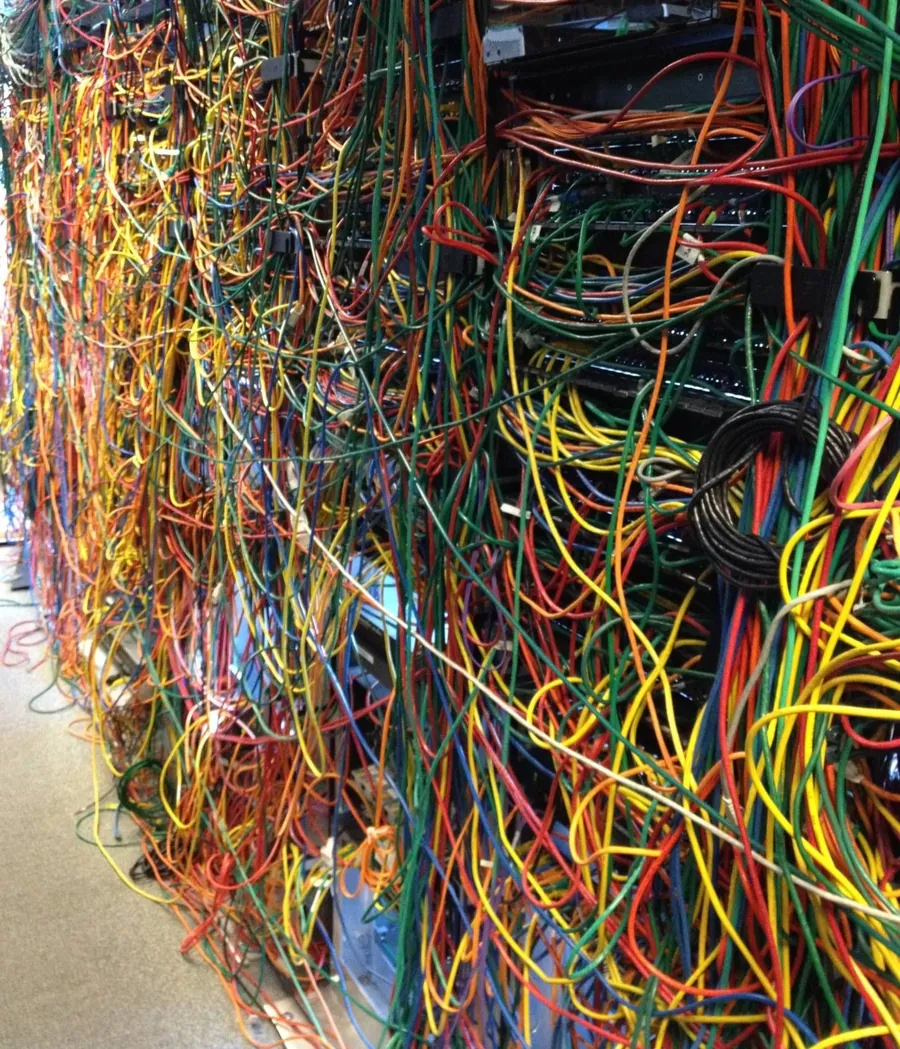
Before: years of quick fixes, nobody tracing what goes where.
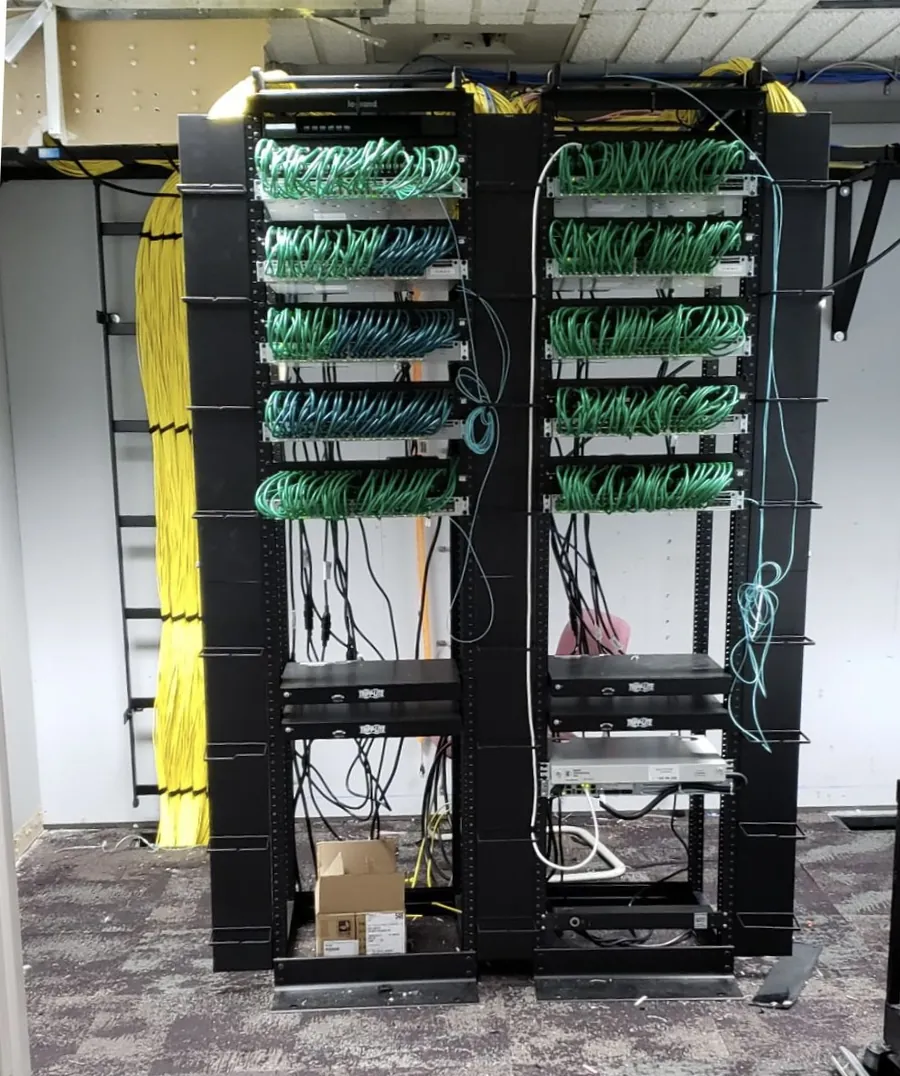
After: labeled, color-coded, dressed into the rack, and tested.
Nobody sets out to build a rat's nest. It happens one cable at a time — a new phone system here, a quick fix there, a run nobody had time to label before moving on to the next fire. Multiply that by a few years and a few different hands in the closet, and you get a tangle like the one in that first photo: color everywhere, direction nowhere.
A messy closet isn't just ugly, it's slow. When something goes down, whoever's troubleshooting has to trace cable by hand through a pile that could be hiding a dead line, a mislabeled run, or a splice nobody's checked in years — and every minute spent untangling is a minute your business sits offline waiting on it.
You can't organize what you don't understand, so this is the part nobody sees in the after photo: following each cable from where it starts to where it actually ends up, not where some old label says it goes. That means being willing to cut loose the runs going nowhere, even when nobody remembers why they were installed in the first place. Every run that survives gets tagged as we confirm it, so nothing gets guessed at twice. It's slow, it's a little tedious, and it's the entire reason the rest of the project goes smoothly.
Once we know what's staying, it gets re-terminated and a proper home: a patch panel system — Leviton and Legrand hardware, in this case — that gives every cable its own labeled port instead of a shared pile. We color-code by function, one shade for data, another for phones, another for whatever oddball system the building has bolted on over the years, then bundle everything and dress it into the rack along real cable paths instead of just cramming it wherever there's room. This is where the closet stops fighting anyone who has to work in it later — including us, on the next service call.
Every terminated run gets tested to confirm it's actually carrying signal, not just sitting there looking tidy, then gets a clear, permanent label on the patch panel. What's left is the rack in that second photo: same room, same equipment, a completely different closet. Airflow improves, a stray cable snag is a lot less likely to take a switch down with it, and the next person who opens that door — client, technician, whoever — can find and fix things in minutes instead of hours.
If the "before" photo gave you a little chest pain because it looks exactly like your own closet, take a breath — you're in good company. That's just what happens when the IT hat gets passed around the office long enough that nobody remembers whose job it actually is. We're happy to take that hat off your hands: give Silver Smith Solutions a call and we'll come take a look, tangle and all, no judgment about what we find behind that door.